
-
Home

-
Blog
-
Construction Blog
- Ohm's Law and Why It Matters for Contractors
Blog
Ohm's Law and Why It Matters for Contractors
 RocketCert Staff
 06.01.2026
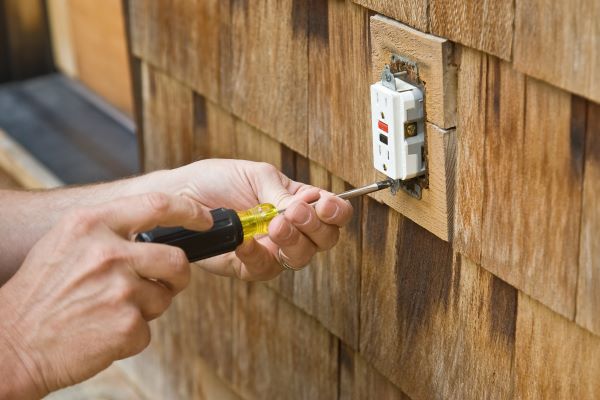
Ohm's law is a fundamental electrical principle that electricians and other contractors must know to do their day-to-day work. It explains the relationship between voltage, current, and resistance, which is essential for any circuit.
Understanding this law is essential for interpreting readings and solving problems, and you'll also need to know it for your licensing exam.
What Is Ohm's Law?
Ohm's law quantifies the relationship between the three basic values of any circuit. It states that when the voltage increases and the resistance stays constant, the current will increase. Conversely, it also means that when the resistance increases and the voltage stays the same, the current decreases.
Voltage can be thought of as the pressure that pushes electric charge through circuits as current. Resistance is the opposition to that pressure, limiting the current. Ohm's law provides the concrete mathematical formula to take these elements of electrical theory and use them to make useful measurements and designs.
The law is named after Georg Ohm, a German mathematician and physicist who made significant contributions to the understanding of electricity in the 1800s.
Ohm's Law Formula
The formula for Ohm's law is fairly straightforward:
V = I x R
“V” stands for voltage, which is measured in volts. “I” represents the current in amps. “R” is the resistance, measured in ohms. Using this formula, you can quickly calculate one value if you know the other two.
You'll sometimes see the formula arranged as:
I = V / R
or
R = V / I
These mean the same thing, just in a form that lets you immediately find current or resistance. For example, you might have a 12-volt circuit with 6 ohms of resistance. 12 divided by 6 is 2, giving you a current of 2 amps.
Why Ohm's Law Is Important
Ohm's law isn't some obscure detail you'll only need to know to pass an exam. It's a practical way of explaining and predicting how a circuit behaves. You can use it to better understand measurements and anticipate how changing out parts will affect performance.
With this understanding, you can reason that a low current points to either reduced voltage or higher resistance. In turn, you'll know that issues like corrosion, loose connections, or failed components are likely affecting the circuit.
Licenses That Require an Understanding of Ohm's Law
There are many different licenses that call for an understanding of Ohm's law (and possibly include questions about it on the accompanying exam). Electrician licenses and related credentials are prime examples. Apprentice, journeyman, and master electricians all need to know this law forward and backward.
You're also likely to encounter Ohm's law in areas like HVAC, alarm systems, appliance repair, and general contractor exams. While the math is fairly straightforward, having a solid grasp of the relationship between voltage, current, and resistance matters in many diverse fields.
Prepare for Your Licensing Exam With RocketCert
If you hope to acquire an electrician's license or other related credentials, you'll need to be familiar with Ohm's law and similar principles. RocketCert can help you get ready with online prep courses tailored to the specific license you're looking to obtain. Get started today and give yourself the best possible shot at acing your exam.

 Facebook
 Twitter
 Linkedin
 Gmail
Gmail